
"bearing Saint Edward's staff," (U15.1443)
St Edward's Staff (= The Sceptre with the Cross, the Sovereign's Sceptre, or the Royal Sceptre) symbolises the temporal authority of the monarch. It was originally made for the coronation of Charles II in 1661. In 1905, it was redesigned to incorporate the Cullinan I, one of the largest diamonds in the world (530 carats). It is held in the right hand during part of the coronation.
St Edward's Staff (= The Sceptre with the Cross, the Sovereign's Sceptre, or the Royal Sceptre) symbolises the temporal authority of the monarch. It was originally made for the coronation of Charles II in 1661. In 1905, it was redesigned to incorporate the Cullinan I, one of the largest diamonds in the world (530 carats). It is held in the right hand during part of the coronation.

"the orb" (U15.1443)
The Sovereign's Orb symbolizes the monarch's role as Defender of the Faith and Supreme Governor of the Church of England. It was created for the coronation of Charles II in 1661 at a cost of £1,150. The Orb is a hollow gold sphere weighing 42 oz and about 16.5 cm (6.5 in.) in diameter. Around the centre is a band of pearls and gemstones. There is a similar half-band running across the top half of the Orb. Atop the Orb is an amethyst surmounted by a Cross.
During the coronation, the Archbishop of Canterbury delivers the Orb to the Monarch's right hand. The Orb is then placed on an altar, where it remains for the remainder of the ceremony. At the end of the ceremony, the Monarch holds the Orb in the left hand, the Sceptre with the Cross in the right hand, and wears the Imperial State Crown as he or she leaves Westminster Abbey.

"and sceptre with the dove, the curtana." (U15.1443)
The Sceptre with the Dove (= the Rod with the Dove, or the Rod of Equity and Mercy), symbolizes the spiritual authority of the Monarch. It was originally made for the coronation of King Charles II in 1661. It is a gold rod with bands of gemstones, surmounted by a sphere and an enamelled dove, representing the Holy Ghost.
The Curtana (= the Sword of Mercy), symbolizes the mercy of the monarch. It is a sword with a blunted square tip (from Latin curtus = shortened). It is believed to have been made for the coronation of Charles I, and to have escaped melting down by Cromwell. The Curtana is the sword used during knighting ceremonies.

"He is seated on a milkwhite horse with long flowing crimson tail, richly caparisoned, with golden headstall. Wild excitement." (U15.1444)

"The ladies from their balconies throw down rosepetals." (U15.1446)

"The air is perfumed with essences. The men cheer. Bloom's boys run amid the bystanders with branches of hawthorn and wrenbushes.)
BLOOM'S BOYS
The wren, the wren,
The king of all birds,
Saint Stephen's his day
Was caught in the furze." (U15.1447)
BLOOM'S BOYS
The wren, the wren,
The king of all birds,
Saint Stephen's his day
Was caught in the furze." (U15.1447)

"A BLACKSMITH
(Murmurs.) For the honour of God! And is that Bloom? He scarcely looks thirtyone.
A PAVIOR AND FLAGGER
That's the famous Bloom now, the world's greatest reformer. Hats off!
(All uncover their heads. Women whisper eagerly.)
A MILLIONAIRESS
(Richly.) Isn't he simply wonderful?
A NOBLEWOMAN
(Nobly.) All that man has seen!" (15.1455)

"A FEMINIST
(Masculinely.) And done!
A BELLHANGER
A classic face! He has the forehead of a thinker.
(Bloom's weather. A sunburst appears in the northwest.)" (U15.1465)
(Masculinely.) And done!
A BELLHANGER
A classic face! He has the forehead of a thinker.
(Bloom's weather. A sunburst appears in the northwest.)" (U15.1465)

"BLOOM
(in dalmatic and purple mantle, to the bishop of Down and Connor, with dignity) Thanks, somewhat eminent sir.
WILLIAM, ARCHBISHOP OF ARMAGH
(in purple stock and shovel hat) Will you to your power cause law and mercy to be executed in all your judgments in Ireland and territories thereunto belonging?
BLOOM
(placing his right hand on his testicles, swears) So may the Creator deal with me. All this I promise to do." (U15.1476)

"MICHAEL, ARCHBISHOP OF ARMAGH
(Pours a cruse of hairoil over Bloom's head.) Gaudium magnum annuntio vobis. Habemus carneficem. Leopold, Patrick, Andrew, David, George, be thou anointed!
(Bloom assumes a mantle of cloth of gold and puts on a ruby ring." (U15.1486)
(Pours a cruse of hairoil over Bloom's head.) Gaudium magnum annuntio vobis. Habemus carneficem. Leopold, Patrick, Andrew, David, George, be thou anointed!
(Bloom assumes a mantle of cloth of gold and puts on a ruby ring." (U15.1486)

"He ascends and stands on the stone of destiny. The representative peers put on at the same time their twentyeight crowns." (U15.1491)

"Joybells ring in Christ church," (U15.1492)

"Saint Patrick's," (U15.1493)

"George's and gay Malahide. Mirus bazaar fireworks go up from all sides with symbolical phallopyrotechnic designs. The peers do homage, one by one, approaching and genuflecting.)
THE PEERS
I do become your liege man of life and limb to earthly worship." (U15.1493)
THE PEERS
I do become your liege man of life and limb to earthly worship." (U15.1493)
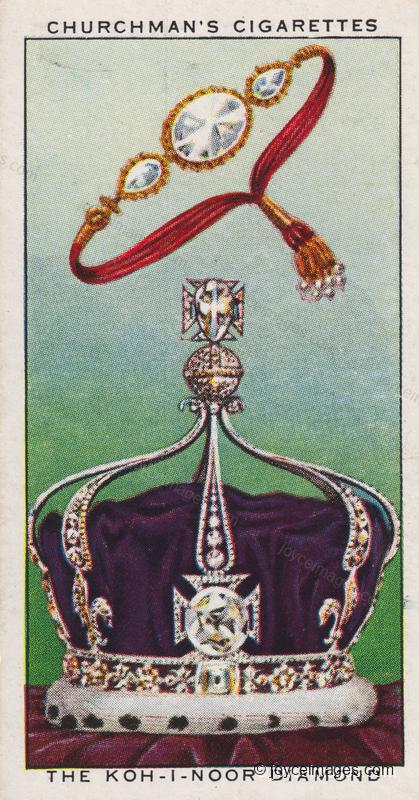
"(Bloom holds up his right hand on which sparkles the Koh-i-Noor diamond. His palfrey neighs." (15.1499)
The Koh-I-Noor (Persian for "Mountain of Light') is one of the largest diamonds in the world, weighing 105.6 carats. It originated in India and was "given" to Queen Victoria after the British annexation of the Punjab in 1849. At the time, it was set in a bracelet that Bloom may be wearing.
The Koh-I-Noor (Persian for "Mountain of Light') is one of the largest diamonds in the world, weighing 105.6 carats. It originated in India and was "given" to Queen Victoria after the British annexation of the Punjab in 1849. At the time, it was set in a bracelet that Bloom may be wearing.

.
The Prince Consort Albert had the Koh-I-Noor recut for Queen Victoria, who wore it in various pieces of personal jewelry (brooch, pendant...). It was set in a platinum crown for the coronation of Queen Alexandra in 1902. The crown was later worn by Queen Mary of Teck, and Queen Elizabeth II. In 1904, the diamond belonged to Queen Alexandra, and is seen here within the larger cross. Only women wear the Koh-I-Noor as, legend states, it brings bad luck to men wearers - including Bloom?
The Prince Consort Albert had the Koh-I-Noor recut for Queen Victoria, who wore it in various pieces of personal jewelry (brooch, pendant...). It was set in a platinum crown for the coronation of Queen Alexandra in 1902. The crown was later worn by Queen Mary of Teck, and Queen Elizabeth II. In 1904, the diamond belonged to Queen Alexandra, and is seen here within the larger cross. Only women wear the Koh-I-Noor as, legend states, it brings bad luck to men wearers - including Bloom?